When a Website Isn't Enough: Signs You Need Custom Software
If your business runs on spreadsheets, phone calls and a shared inbox, the problem isn't your website. Here's how to tell when you've outgrown pages and need an actual application.
Jared Leagan
ProStart Solutions
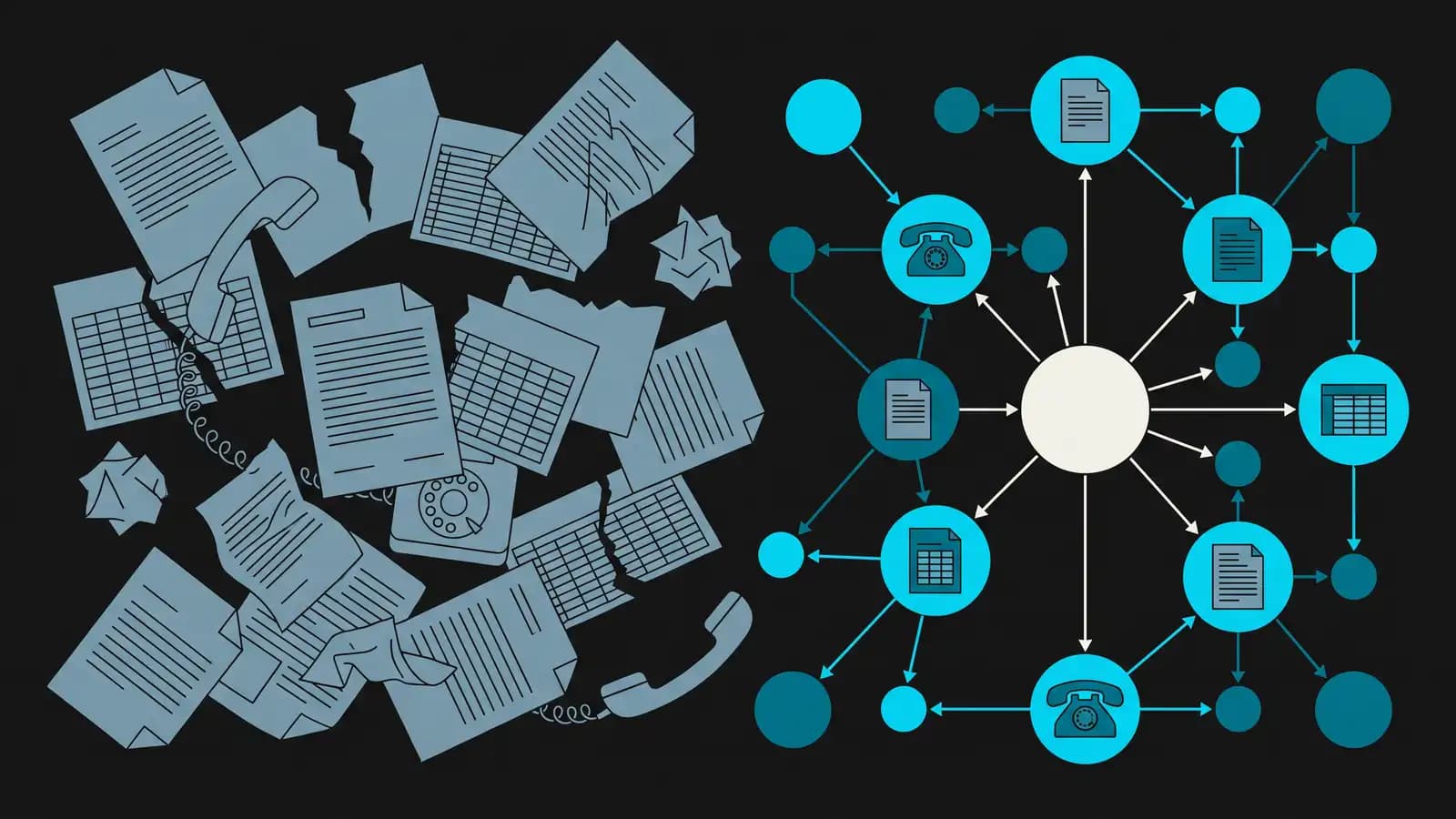
The Spreadsheet Tell
There is a moment in a growing business when the website stops being the bottleneck.
You can usually spot it by what people are actually doing all day. Someone is maintaining a spreadsheet that three other people email updates into. Orders arrive by phone and get written on a pad. Two systems hold the same customer list and neither agrees with the other. Somebody's job title has quietly become "the person who knows where things are."
None of that is a web design problem. Adding another page to your site will not fix any of it. What you have outgrown is not your website — it is the absence of a system underneath it.
What Separates a Site From an Application
A website presents information. Someone visits, reads, and hopefully calls you.
An application holds state. It knows who is logged in, what they are allowed to see, what happened last Tuesday, and what has to happen next. It enforces rules rather than trusting everyone to remember them. The distinction is not how it looks — plenty of applications look like ordinary websites — it is whether the thing has a memory and opinions.
Most small business software needs fall into a handful of shapes:
- A record that has to survive a handoff. Something is tracked across multiple parties, and today the trail lives in email.
- A process with an order to it. Steps must happen in sequence, and skipping one causes an expensive problem later.
- Different people seeing different things. Staff, customers and suppliers all need access, but not to the same data.
- A number nobody can currently produce. Someone asks how many, and the honest answer takes a day of digging.
If two or more of those describe your week, you are already running an application. It is just being executed by people instead of software, and people are expensive and inconsistent at it.
A Worked Example
HVACR Passport is the clearest version of this we have built, so it is worth walking through.
An HVAC unit effectively vanishes the moment it leaves the loading dock. The manufacturer loses serial-level visibility. The distributor takes parts orders by phone and fax. The contractor has no proof to lean on in a warranty dispute. The homeowner has no idea what is installed or what is still covered. The record lives in spreadsheets and phone calls — which is precisely where disputes and warranty fraud come from.
Notice that none of those are complaints about a website. They are complaints about a missing record.
What we built gives every unit one record, created at the factory and carried through to the homeowner. Units move through an enforced seven-step lifecycle — nothing ships without passing QC, nothing is marked installed without the details that make a warranty real — and every transition is audit-logged. A single unit URL lives in both a QR code and an NFC chip, so the physical box and the digital record point at each other.
On top of that sit five surfaces: portals for manufacturers and dealers, a browser app for homeowners and inspectors, and native iOS and Android apps built in React Native. The contractor app is the one that has to work in a crawlspace — it reads the NFC tag off the unit, records the install and startup survey, and messages the homeowner from the field. Manufacturers are isolated tenants, so a distributor can carry ten brands without any of them seeing each other.
That is the difference in a sentence: the website tells you the company exists, the application is the company's operating system.
The Questions Worth Asking First
Custom software is a real investment, and the fastest way to waste it is to build the wrong thing. Before anyone writes code:
- What is the one number this should make easy to produce? If you cannot name it, the project has no edges.
- Who actually has to log in, and what must they never see? Permissions are cheap to design up front and painful to retrofit.
- What happens today when someone does it wrong? That is the rule the software needs to enforce.
- What must it talk to? Accounting, payments, email, an existing database. Integrations decide a surprising amount of the architecture.
- What is the manual version? If you cannot describe the process on paper, software will only automate the confusion.
A good build partner should push back hard on all five before quoting. If someone quotes you a price without asking any of them, they are quoting a template.
What It Doesn't Have to Be
Two common fears, both usually unfounded.
It does not have to be everything at once. The useful version is almost always narrower than the one people first describe. Build the piece that removes the worst daily pain, get it in front of real users, and let what they actually do decide phase two.
It does not have to be a rewrite of how you work. Good software mirrors the process you already run, minus the parts that only exist because a spreadsheet cannot enforce anything.
Where to Start
If the description at the top of this page felt uncomfortably familiar, the next step is not a quote — it is a conversation about what the actual process is. We do those for free, and a fair number of them end with us saying the problem is smaller than you thought and does not need custom software at all.
You can see the range of what we build under web applications and business software, or browse the full portfolio. If the process in question is reservations — a campground, hostel or small lodging business juggling online, phone and walk-in bookings — our booking systems page walks through the engine we built for Jeff Davises Hostel & Campground. When you want to talk it through, get in touch.
If what you need is a mobile app specifically, our cost estimator will give you a realistic range in a couple of minutes without anyone calling you.
Ready to put these insights into action?
Get a free consultation and see how ProStart Solutions can help your business grow online.
Get Free ConsultationKeep reading
One Page Per Town: How Local SEO Structure Actually Works
Most local businesses try to rank one page for every town they serve. Here's why that fails, what building a page per service per market looks like, and the real numbers from a site we did it on.

What Happens to a Website After Launch
Nobody warns you that a website is a depreciating asset. Here's how sites quietly rot in the first two years, and what a maintenance plan is actually paying for.